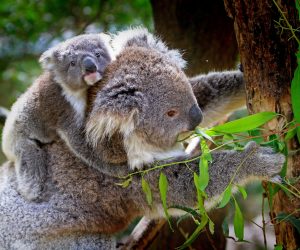
Rose Adams explains how recent legislative changes have swept away many of the safeguards that were in place to protect koala habitat in Queensland, making it easier for developers to cut through the so-called ‘green tape’. What happens to the koalas living in an area earmarked for development? In the very bad old days, animals were simply chased away, “thrown over the fence” (a quote from a former Town Planning officer) or just ignored. It was assumed they would move on, find new trees and somehow adapt to their changed circumstances. The reality is, however, that koalas cannot successfully co-inhabit spaces where their food trees are drastically reduced to make way for housing. The accompanying roads, speeding cars, domestic pets, lights and noise all result in unbearable stress, injury and often their death of these iconic Australian animals.

The koala is perhaps the most iconic Australian animal, and is a popular species with international visitors. According to very recent research by the Australian Koala Foundation (AKF), it has been estimated that koala-related tourism generates $3.2 billion in revenue annually across Australia and also generates around 30,000 jobs Queensland is fortunate to have one of the largest natural populations of koalas in the wild. Koala populations are scattered across the eastern half of Queensland, as far west as Cunamulla, Quilpie, Longreach and Hughenden and as far north as Cooktown. However, the highest densities of koalas occur in the south east corner of the State.

GECKO and GECKO’S RESPONSE TEAM strongly supported Wildlife Queensland’s campaign to have opera house traps banned in Queensland. Well the Government has just flagged they are going to be banned! This has been a long six year fight and sense has finally prevailed. The laws will bring Queensland in line with the rest of the States.

The Single State Planning Policy has done nothing to protect koala habitat. If the government isnt going to protect Australia's icon, who can? People are needed to partake in a survey and maybe the results will stir someone on government to change the laws and bring back vegetation protection and stop development in koala habitat

RESIDENTS have stepped up their efforts to save the Black Swan Lake at Bundall and the 32 bird species that call it home. The Gold Coast and Hinterland Environmental Council (Gecko) has also thrown its weight behind the residents’ campaign, saying the lake should be protected at all costs. The council-owned waterhole off Ascot Crt has been earmarked as a parking area as part of the $11 million upgrade of the Gold Coast Turf Club site to create the new home of the Gold Coast Show. However, Sally Spain, spokeswoman for the Residents and Friends of Black Swan Lake lobby group, said they were determined not to lose the quiet, secluded haven for birds.

It has been called the largest ever climate march in history and it was a huge success globally. Seven Gecko members attended the march in Brisbane on the 21 September 2014. Here is a video recap of the response Australia wide and overseas. Thanks to Get Up for this great piece of recorded history!

Below are the letters for your information to write your submission to the Gold Coast City Council on Springbrook water extraction. Please make sure if you do use our submission letter below that you add your own comments to individualise your submission. The same submission letter repeated by different people can sometimes be treated as one letter so it’s important that you do add your own comments.

Queensland State Government passed the Vegetation Management Framework Amendment Act (2013) late last year. The aim of the Bill, as stated by Government, is to reduce red tape and regulatory burden on landowners, business and government. The Amendment Bill repealed critical regrowth regulations on freehold and indigenous lands, removed enforcement and compliance provisions, removed significant and historic multifactorial vegetation mapping and introduced self-assessable codes. While removing red tape and streamlining development processes, the Amendment Bill significantly weakens the protection of critical vegetation on watercourses and exposes hundreds of thousands of hectares of high value regrowth vegetation to broad-scale land clearing.

In 2013 the VMFA Bill was passed with such major changes that the consequences will have far reaching economic, environmental and social negative impacts. At its time of its writing this Bill did not given sufficient consideration to the negative impacts and was only viewing it through a narrow prism of short term economic gain for one sector of society. Further the changes are not based on sound science, but rather an aspiration based on economic considerations only.

Since the current Government came to power 2012 they have made substantial changes to the status of conservation under the Nature Conservation Act so that the conservation of nature is no longer the primary objective of the act; moved the National Parks portfolio from the Department of Environment to the current portfolio which has shifted the focus of national parks from conservation to exploitation for human benefit; put out tenders for allowing commercial activities in national parks; allowed other previously banned activities in national parks such as horse riding; trail bike riding and four wheel driving; undertaken a review of national parks with criteria that is strongly weighted to economic benefits rather than conservation.